In spring 2023, crews at Penthouse Towers cleared scaevola from the dune behind the building, and something unexpected came up. The Coastal Star reported that burrowing four o'clocks, also called beach peanut, appeared and spread quickly across the cleared sand. The plant is endangered and grows only in South Florida. It dies back almost as fast as it arrives and leaves behind a seed bank that can sprout again after a good spring rain. The same report called its yearly return a welcome sign that a dune is going back to its natural state.
Those seeds had been in the sand behind one building all along. They were waiting for one association to decide what should grow there. That is how Highland Beach's dune works. Each building decides for its own stretch of sand, and the Town's newest effort to bring back native plants has to win over one building at a time.
Three Miles of Separate Decisions
Most coastal towns treat the dune as one public system. Highland Beach's beaches are private, so the dune behind each condo or home is its owner's to manage. The Coastal Star has noted that the Town has only private beaches and few options for federal or state renourishment projects. Because of that, town commissioners asked the Natural Resources Preservation Advisory Board to run an education campaign on dune restoration instead.
The private ownership shapes even volunteer work. The board's February 2025 minutes record that school cleanup efforts were limited to Parker Highland's property because the nearby beachfront was private. The same meeting split up outreach to condo associations among board members. So restoration here depends on talking to people. A board member knocks on a management office door, leaves information, follows up, and waits for a board vote.
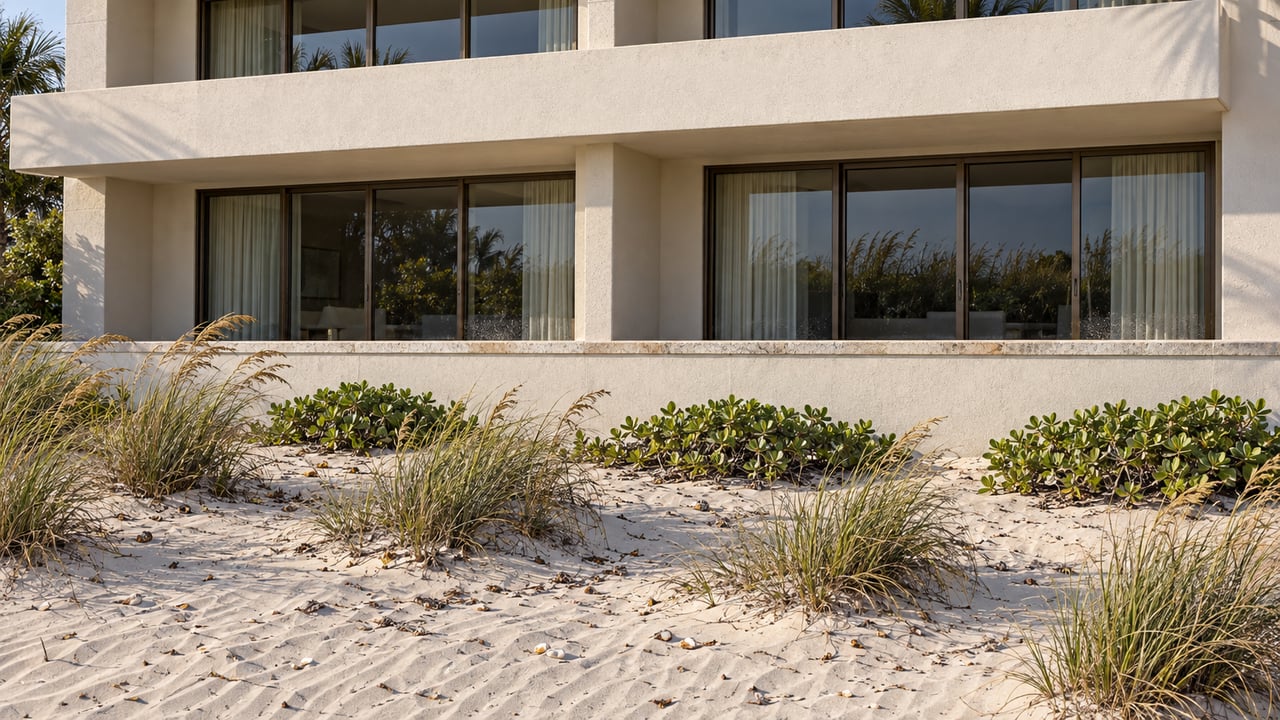
On a walk, that shows up as a patchwork. Sea oats run behind one building, a hedge of trimmed sea grape sits behind the next, and a low green carpet of ground cover comes after that. Those changes match property lines, not anything about the sand itself.
What the Town Sent Condo Managers in October
On October 28, 2026, the advisory board sent a letter addressed "Dear Condominium Manager." The Town posted it online the next day. It says that over the past few years, many condominiums and homeowners have already swapped invasive vegetation for native sea oats. It offers to explain "how straightforward and cost-effective restoration can be," either directly or in a short presentation at a building's next board meeting.
The letter makes its case to board members in three bullet points:
Lower maintenance costs: Eliminates continuous, costly trimming of sea grapes and overgrown non-native species. Stronger storm defense: Deep-rooted sea oats naturally build sand elevation and protect structural integrity. Minimal ongoing upkeep: Requires only occasional removal of weeds and non-native growth.
Two of the three points are about the landscaping budget. That fits who reads the letter. A condo board weighs the dune against the cost of trimming it. The letter argues that the native version is the cheaper one to keep up. It names Barbara Nestle, the board's chairperson, as the contact. It closes by calling the dunes and beach a key asset of the Town's "Three Miles of Paradise."
The Dune, Building by Building
Chair Nestle gave the board a 2026 status report that tracks outreach to each oceanfront condominium on South Ocean Boulevard. The buildings with planting done or underway, listed in address order:
- Villa Magna, 2727 S Ocean Blvd. Sea oats went in during December 2025, and restoration is listed as in progress.
- Highlands Place, 2901 S Ocean Blvd. Work began in 2025, and planting is scheduled for 2026.
- The Clarendon, 3407 S Ocean Blvd. This is the longest-running effort on the list. Invasive plants have been coming out since 2015. In 2024, panic grass was allowed to seed the first 15 feet of sea oats on the water side. The report calls the planting well established.
- Regency Highland, 3912 S Ocean Blvd. A planting event with a charity took place in 2025.
- Parker Highland, 4605 S Ocean Blvd. Restoration is finished along 400 feet of private beach frontage.
- Penthouse Towers, 4748–4750 S Ocean Blvd. The report calls it an established model of dune replenishment and native sea oats.
Most of the report's other entries are still at the outreach stage. Coronado Condominiums, at 3400–3420 S Ocean Blvd, is listed as a possibility for 2026–27, with a beach project in planning. So the restored stretches don't form one continuous strip. They are scattered along three miles, with gaps between them.
Reading the Plants on a Morning Walk
The Penthouse Towers project is the clearest local example of what a replanted dune looks like. According to The Coastal Star's account, the building had tried a restoration about a decade earlier. Some plants died, and others were crowded out by scaevola, a fast-growing, shallow-rooted ground cover. In early 2023, with help from its beach-raking contractor, the building cleared most of the exotics. Residents then started planting sea oats under the guidance of Lee Gottlieb, founder of Adopt a Dune. Later plantings added:
- Beach sunflower
- Beach creeper
- Sea purslane
- Bay cedar, a threatened or endangered species
- Sea lavender, also threatened or endangered
Rob Barron of Coastal Management and Consulting told the paper that about 200 native plants can be used to restore dunes. The Coastal Star put the project's cost at under $15,000, and the building's manager at the time, Elaine Prentice, put the goal simply: "The dune has to be functional but it also has to be attractive."
Next door, in Delray Beach, it's possible to see what decades of patience produce. Barron described a 10-foot-wide strip of sea oats that the city planted in 1984. By 2023 it had spread to about 160 feet wide and had trapped roughly 12 vertical feet of sand. Compared with that, The Clarendon's 15-foot band of panic grass and sea oats is an early-stage project. Villa Magna's sea oats, planted last December, have been in the ground for less than a year.
The calendar is part of this too. The Town lists sea turtle nesting season as March 1 through October 31, so the season was in its final days when the October 28 letter went out. The Coastal Star also notes that a restored dune provides habitat for birds and other wildlife, sea turtles among them.
Where the Next Stretch Gets Decided
The next public step is the Highland Beach Dune Restoration Breakfast. It's set for Wednesday, November 18, at 9:30 a.m. at Delray Sands Resort, 2809 S Ocean Blvd. The advisory board is hosting, and the Town's announcement describes a complimentary breakfast on how residents and condominiums are working together to restore the shoreline. Valet parking costs $10. The posted RSVP date was October 30, so anyone who wants to go should contact the organizer listed in that notice to ask about space.
For buildings that haven't started, the board's letter offers a short presentation at a condo board meeting. Its listed contact is Chair Barbara Nestle. State rules also apply on the beach side of the line. Florida Statute 161.053 prohibits damaging a dune or the vegetation growing on it seaward of the Coastal Construction Control Line. It also sets out permits, exceptions, and a general permit for qualifying dune-restoration projects. The Florida Department of Environmental Protection publishes dune planting recommendations. DEP notes that this guidance does not cover regulated work such as sand fill, sand fences, or irrigation systems. This is general information, not legal advice. Any association planning dune work should confirm its own requirements with the agencies and professionals involved.
If you'd like to know how your building's stretch of beach fits into that picture, or what the shoreline looks like behind buildings you're considering, the team at Bernal & Hudson is glad to share what we know about Highland Beach's oceanfront communities.